
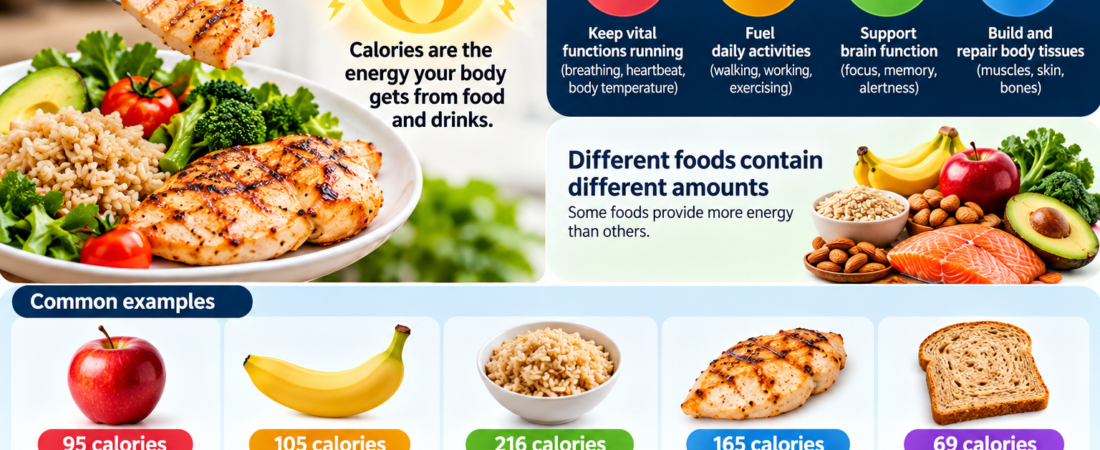
What is a calorie? Put simply, it is a unit used to measure energy. Food and drinks provide energy in the form of calories, while your body uses that energy to breathe, move, stay warm, digest food and carry out countless processes every day. Calories are not inherently “good” or “bad”, and eating a particular number does not determine your health or your personal worth.
Calories come from the nutrients in food, including carbohydrate, protein and fat. Alcohol also provides energy. Different foods contain different amounts, but every food can have a place in a balanced diet. Enjoying a favourite treat does not cancel out healthy habits, just as choosing a nutrient-rich meal does not make someone morally better. What matters is the overall pattern of eating, alongside factors such as sleep, activity, stress, medical conditions and access to nourishing food.
Your body constantly balances the energy it receives with the energy it uses. When intake is greater than expenditure over time, the body may store some of the extra energy. When intake is lower, it may draw on stored energy. This relationship is often described using terms such as calorie deficit and calorie surplus. However, real bodies are not machines with perfectly fixed settings: appetite, hormones, movement, medication, illness and many other influences can affect how this process works.
This guide explains where calories come from, how the body uses them and how energy intake can relate to changes in body weight. It also explores why food quality matters, since calories alone do not describe fibre, vitamins, minerals, protein, fullness or enjoyment. If you are interested in weight loss, these ideas can provide useful information without promoting rigid rules or judgement. Body weight is only one aspect of health, and people can support their wellbeing in many different ways and at many different sizes.
A calorie is a unit used to measure energy. When people discuss the energy in food, they are describing how much energy that food can provide to the body. The body uses this energy to support essential functions such as breathing, circulation, movement, digestion and maintaining body temperature.
In scientific terms, a calorie is a relatively small unit of energy. A kilocalorie, abbreviated as kcal, equals 1,000 of these small calories. However, nutrition labels, dietary guidance and everyday conversation generally use the word “calorie” to mean a kilocalorie. This difference often leads people to search for an explanation of kcal vs calorie, although the terms are usually referring to the same practical measurement in nutrition.
The main terms can be compared as follows:
Term: Calorie. Meaning: A small scientific unit of energy. How it appears in nutrition: It is less commonly used on food labels, where “calorie” normally means a kilocalorie.
Term: Kilocalorie (kcal). Meaning: 1,000 small calories. How it appears in nutrition: This is the technical unit most often intended when nutrition professionals state the calorie content of food.
Term: Food-label “Calories.” Meaning: The nutrition-industry version of kilocalories. How it appears in nutrition: A package listing 200 Calories is generally reporting 200 kcal. The capital C may be used to distinguish these food Calories from small scientific calories.
A calorie count therefore describes the amount of energy a food supplies, not its overall quality. It does not show whether a food is rich in vitamins, minerals, fiber or protein, nor does it indicate how filling the food will be. A food with fewer calories is not automatically more nutritious, and a particular calorie amount may not suit every person. Energy needs vary according to factors such as age, body size, activity level, health status and individual goals.
The energy in food comes mainly from three macronutrients: carbohydrate, protein and fat. Alcohol can also provide energy, although it is not generally classified as a macronutrient in the same way. Widely accepted Atwater values estimate that carbohydrate supplies about 4 kilocalories (kcal) per gram, protein supplies 4 kcal per gram, fat supplies 9 kcal per gram, and alcohol supplies 7 kcal per gram. These figures provide a practical basis for understanding the calorie content shown on food labels.
Atwater values are general averages rather than exact measurements for every food. The energy a food provides can vary slightly because foods differ in composition, preparation and digestibility. Bread, rice and fruit commonly provide carbohydrate. Meat, fish, eggs, beans and yoghurt can provide protein, while oils, nuts, seeds, butter and avocado are notable sources of fat. However, foods are rarely made up of only one nutrient. For example, beans contain both carbohydrate and protein, yoghurt may contain protein and fat, and nuts provide fat alongside protein and some carbohydrate.
Fibre may be handled differently depending on the nutrition-labelling system and the rules used in a particular country. Some systems assign fibre a small amount of energy, while others do not include it in the same way. Readers therefore do not need to calculate every gram manually; the calorie value on a label is usually the most useful guide for everyday choices. Fat is more energy-dense because it provides more than twice as many calories per gram as carbohydrate or protein. This does not make fat inherently unhealthy. The type of fat, the amount consumed and the overall eating pattern are more important than calorie density alone.
Your body uses calories continuously, whether you are exercising, working, sleeping, or sitting quietly. Total daily energy expenditure is the combined amount of energy required to keep essential processes running, support movement, and handle the food you eat. It is useful to think of this expenditure as three broad, overlapping parts.
The largest part for many people is basal metabolic rate, or BMR. This is the energy your body needs at rest to maintain vital functions, including breathing, blood circulation, body temperature, brain activity, and the work of organs and cells. BMR does not mean the total number of calories you need in a day, because most people do not remain completely still. It is one component of overall energy use, not a recommended calorie intake or a target that must be eaten or burned.
Physical activity forms another part of daily energy expenditure. This includes planned exercise such as cycling, swimming, strength training, or running, but it also includes ordinary movement. Walking between rooms, standing, climbing stairs, completing household tasks, carrying items, and moving during work can all require energy. The amount varies substantially between people and can change from one day to the next, depending on routines, occupation, health, and other circumstances.
The third part is the thermic effect of food, which is the energy used to digest, absorb, and process nutrients after eating. Different foods require different amounts of processing, and the effect is generally smaller than the energy used for basic body functions or movement. Together, these three areas determine how much energy your body uses over time.
BMR and calorie calculators can provide a helpful starting estimate, but they cannot measure an individual’s needs exactly. Energy requirements naturally fluctuate with activity, sleep, stress, illness, appetite, and changing body conditions. For that reason, calorie figures are best understood as approximate information rather than precise instructions. Paying attention to regular eating patterns, hunger, fullness, and overall well-being can offer useful context alongside any numerical estimate.
Calorie needs are different for every person and can change throughout life. Age, body size, sex, muscle mass and activity level all influence how much energy the body uses. Someone with more muscle tissue may require more energy at rest, while a physically demanding occupation generally increases daily needs compared with desk-based work. The body also requires additional energy during childhood and adolescence, pregnancy and breastfeeding. Illness, injury and recovery can alter appetite, metabolism and nutritional requirements as well.
A calorie calculator can estimate the number of calories someone may need to maintain their current weight. However, this figure is a starting point rather than a precise personal target. Calculators rely on general equations and cannot fully account for differences in metabolism, movement, health or everyday routines. Actual needs are better understood over time by considering hunger, energy, concentration, exercise performance, recovery, sleep and changes in body weight or other health measures across several weeks.
Calorie targets should be approached flexibly, not treated as a score or a measure of discipline or personal worth. Very low-calorie targets and highly restrictive eating plans can increase the risk of nutrient deficiencies, fatigue, poor concentration and an unhealthy relationship with food. Extra care is important for teenagers, people who are pregnant or breastfeeding, anyone with a history of disordered eating, and those living with a medical condition. In these situations, a calculator should not be used to set an independent diet plan.
Before making major changes to food intake, speak with a GP, registered dietitian or another qualified healthcare professional. They can consider individual circumstances and help create an eating pattern that supports health, growth, activity and recovery. A flexible estimate, combined with professional guidance and attention to the body’s signals, is usually more useful than pursuing one exact number.
Calories describe the energy supplied by food and beverages, while the body continually uses energy to support basic functions, movement, digestion and other activities. Comparing average calorie intake with average energy expenditure over time helps explain common changes in body weight. This relationship is useful, but it should be understood as a trend rather than an exact daily calculation.
A calorie deficit occurs when average intake is lower than average energy use over a period of time. When this pattern is sustained, the body may draw on stored energy, which can lead to weight loss. People often refer to this approach when discussing calories to lose weight. A modest, sustainable deficit is generally more practical than severe restriction because it may be easier to maintain while still allowing adequate nutrition, enjoyment and flexibility. There is no single deficit that suits everyone, and individual needs vary.
Maintenance describes a broad balance between calorie intake and energy expenditure over time. When intake and use are approximately matched, body weight tends to remain relatively stable, although normal fluctuations still occur. A calorie surplus means that average intake is higher than energy use. If maintained, this extra energy can support weight gain, whether the goal is building muscle, recovering from illness or addressing inadequate body weight.
These concepts do not mean that body weight must change predictably from one day to the next. Water retention, glycogen stores, digestion, hormones and bowel contents can cause short-term increases or decreases that do not represent changes in body fat. Weight-loss progress is therefore rarely perfectly linear. Plateaus can also occur as body weight changes and energy needs gradually adjust, sometimes reducing the original deficit. Monitoring longer-term patterns rather than isolated weigh-ins provides a clearer picture. Sustainable habits, adequate protein and other nutrients, regular activity, sleep and realistic expectations are generally more valuable than extreme rules. Anyone with a medical condition, a history of disordered eating or substantial nutritional concerns should seek advice from a qualified health professional before deliberately changing calorie intake.
A calorie describes the amount of energy food provides, but it does not reveal everything about that food. Two items may contain a similar number of calories while differing substantially in protein, fibre, vitamins, minerals, water content and their ability to create lasting satisfaction. For example, a meal rich in vegetables, fruit and other minimally processed ingredients may provide more nutrients and volume than a snack with an equivalent energy value. Taste and enjoyment matter too, because a satisfying eating pattern is generally easier to maintain than one based only on numerical targets.
Health-supporting meals often combine several food groups. Vegetables and fruit contribute fibre, vitamins, minerals and hydration; wholegrains, potatoes, rice or other carbohydrate sources provide energy; and foods such as beans, lentils, eggs, fish, dairy products, tofu or lean meat can supply protein. Sources of unsaturated fat, including nuts, seeds, avocado and olive oil, add flavour and help make meals more satisfying. Protein and fibre often promote fullness, although individual responses differ. Highly processed foods can sometimes be eaten quickly and may feel less filling for some people, particularly when they contain little fibre or protein.
This does not mean that less nutritious foods are forbidden. Cakes, sweets, crisps and other treats can have a place in a varied diet, especially when enjoyed in moderation and without treating foods as morally good or bad. Rigid rules may make eating more stressful and can distract from overall habits.
Food choices are also shaped by taste, culture, budget, availability, cooking skills and convenience. Medical conditions, allergies and dietary requirements may call for personalised advice from a qualified healthcare professional. Consequently, calorie counting alone cannot assess diet quality. A balanced pattern that provides useful nutrients, adequate nourishment and enjoyment is generally more meaningful than continually pursuing the lowest possible number.
Counting calories can be useful for learning how much energy different foods provide, but it does not need to become a constant task. Start by checking nutrition labels and looking carefully at the serving size. A packet, bottle, or box may contain several servings, so the calories listed for one serving might be lower than the amount you actually eat. Also check calories from cooking oils, sauces, dressings, sweetened drinks, and small snacks when a more accurate estimate is important.
A food-tracking app can make recording meals convenient, while a written food diary may work just as well. Treat database entries and restaurant calorie figures as estimates: recipes vary, entries can contain mistakes, and portions served outside the home are not always measured precisely. The goal is to notice patterns, not to create a perfect record. Reviewing intake over several days is generally more informative than reacting to one unusually large or small meal.
Weighing or measuring food for a short period can help you learn what familiar portions look like. It is a learning tool, not a requirement to continue indefinitely. Other approaches include repeating balanced breakfasts, planning meals in advance, using hand-sized portions, or dividing a plate between vegetables, protein, and carbohydrate foods. Pausing to check hunger and fullness can add useful information that calorie numbers cannot provide.
Helpful habits include:
• Record meals soon after eating, if that feels manageable.
• Use consistent estimates rather than changing methods repeatedly.
• Leave room for treats and flexible social meals.
• Review weekly patterns instead of judging individual choices.
• Adjust portions gradually, based on energy, hunger, and goals.
Calorie tracking is not suitable for everyone. People with a history of disordered eating, intense anxiety about food, or compulsive tracking should avoid beginning or continuing it without guidance. A registered dietitian, doctor, or qualified mental-health professional can suggest a safer approach focused on nourishment and wellbeing.
Is a calorie the same as a kcal?
In everyday nutrition, calorie and kilocalorie (kcal) are usually used interchangeably. Technically, one kilocalorie equals 1,000 small calories, but food labels commonly use “Calories” with a capital C to mean kilocalories. Therefore, a label listing 200 Calories generally means 200 kcal.
Do all calories affect the body in the same way?
Calories provide energy, but foods can affect the body differently. Protein, carbohydrates, fats, fibre, vitamins and minerals each have distinct roles. Food quality, portion size and how filling a meal is can influence hunger, energy levels and overall health. A balanced eating pattern matters, not only the calorie number.
How many calories should I eat to lose weight?
There is no universal calorie target for weight loss. Needs vary according to factors such as age, body size, activity, health and personal goals. Weight loss generally requires using more energy than the body receives over time, but an appropriate approach should provide adequate nourishment. A healthcare professional or registered dietitian can help establish a suitable plan.
Can I lose weight without counting calories?
Yes. Some people manage weight without detailed tracking by choosing balanced meals, serving reasonable portions, eating slowly and limiting foods or drinks that provide little nourishment. Regular routines, sufficient sleep and attention to hunger and fullness cues may also help. These strategies are not a guarantee, and progress can differ between individuals.
Should I exercise to burn off calories?
Exercise can contribute to energy balance, but its value extends beyond burning calories. Regular movement supports cardiovascular fitness, strength, mobility, mood and overall health. Choose activities that are safe and enjoyable rather than treating exercise as punishment for eating. Large diet changes or exercise plans should be discussed with a healthcare professional. Very low calorie diets should not be undertaken without medical supervision. learn more about how to maintain consistent calorie count with help the calorie application